Safe
Hydrogen bound within solid materials under moderate conditions, avoiding high-pressure storage
Storing hydrogen inside solid materials instead of high-pressure tanks — safer, denser, and far easier to design into the systems that need it. An open research question, taken through modelling and materials work into instrumented test hardware.
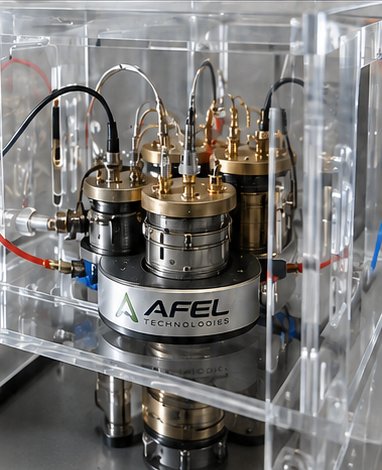
Conventional hydrogen storage compresses the gas to very high pressure or liquefies it at cryogenic temperature. Both work, and both bring consequences: heavy vessels, demanding safety cases, and a volume penalty that rules hydrogen out of a lot of otherwise sensible applications.
Solid-state storage takes a different route — hydrogen is absorbed into a solid material and held there under far gentler conditions, then released when heat is applied. The engineering difficulty moves from containing pressure to managing heat and material behaviour, which is precisely the kind of problem we are set up to work on.
Hydrogen bound within solid materials under moderate conditions, avoiding high-pressure storage
Higher volumetric density allows smaller, more integrated systems
Heat management designed to reduce the external energy needed to release hydrogen
Modular architecture for integration across a wide range of platforms
Suited to military and critical-infrastructure duty where failure is not an option
Serious materials work needs both an operational problem to aim at and academic depth behind it. This program has each.
Collaborating on solid-state hydrogen storage to support the energy needs of advanced military platforms, where safety and compactness are operational requirements rather than preferences.
Partnering on the underlying research to advance hydrogen storage technology and shorten the distance between laboratory result and real-world deployment.
Reliable power for defence vehicles, UAVs and deployed field systems.
Clean, dependable energy for isolated sites and critical infrastructure.
Material handling, backup power and continuous industrial operations.
Compact hydrogen solutions where tank volume is the limiting constraint.
We work with defence, industrial and research organizations on integration studies, joint development and funded research. Tell us about the application.
Get in touch